ADI Resourcing Thailand

THE SUMMARY
Creating ADI Resourcing's first recruiter platform to streamline recruitment operations, improve collaboration, and establish a scalable foundation for regional growth across Southeast Asia.
FROM MANUAL TO SCALABLE
ADI Resourcing operates across ten countries, helping businesses hire talent through recruitment, outsourcing, payroll, and Employer of Record (EOR) services.
As the recruiter network continued to grow, one challenge became increasingly apparent. Independent recruiters had no centralized platform to manage their daily operations. Candidate submissions, placement updates, commission tracking, and recruiter communication relied heavily on email, WhatsApp, and LINE, creating fragmented workflows that were difficult to scale.
Rather than simply digitizing existing processes, ADI saw an opportunity to create a dedicated recruiter platform that could become the operational backbone of its regional recruitment network.
LAYING THE GROUNDWORK

AI-ASSISTED DESIGN WORKFLOW
Throughout the project, I leveraged AI to accelerate research, ideation, and design exploration. ChatGPT supported research synthesis and feature discovery, while Figma Make enabled rapid interface exploration before refining concepts into production-ready designs. By automating repetitive tasks, AI allowed me to focus more on product strategy, stakeholder collaboration, and user experience.
WHERE BUSINESS MEETS USER EXPERIENCE
The discovery phase focused on understanding business operations and recruiter workflows simultaneously. I worked closely with stakeholders to understand:
Current recruitment operations
Business objectives
Future expansion plans
Operational pain points
At the same time, recruiter feedback helped validate where independent recruiters struggled throughout their day-to-day workflow.
To accelerate research insights and identify recurring behavioural patterns, I incorporated AI-assisted research using ChatGPT, allowing me to organize qualitative findings, explore multiple hypotheses, and validate problem framing before translating them into product opportunities.
Rather than replacing design thinking, AI became a collaborative research assistant that helped accelerate insight generation while final decisions remained grounded in stakeholder discussions and user feedback.
WHAT WE LEARNED
Across stakeholder discussions and research insights, several themes consistently emerged. These findings shifted the focus from building features to designing a platform that supports how recruiters actually work.
01.
A Disconnected Recruitment Experience
02.
Limited Visibility Reduced Trust
03.
The platform needed to scale from day one

FROM INSIGHTS TO PRODUCT STRATEGY
01.
Simplify recruiter onboarding
02.
Centralize recruitment workflows
03.
Improve operational transparency
04.
Build for future expansion
DESIGNING WITHIN CONSTRAINTS
One of the biggest challenges wasn't identifying opportunities. It was deciding what not to build.
Working alongside stakeholders and engineers, every proposed feature was evaluated against three considerations:
Business impact
Implementation effort
Technical feasibility
Using the RICE prioritization framework, we transformed backlogs into an achievable product roadmap.
Rather than attempting to launch every feature at once, we deliberately focused on building the platform steadily. This allowed the team to reduce delivery risk while validating assumptions through each release.


BUILDING A CORE EXPERIENCE
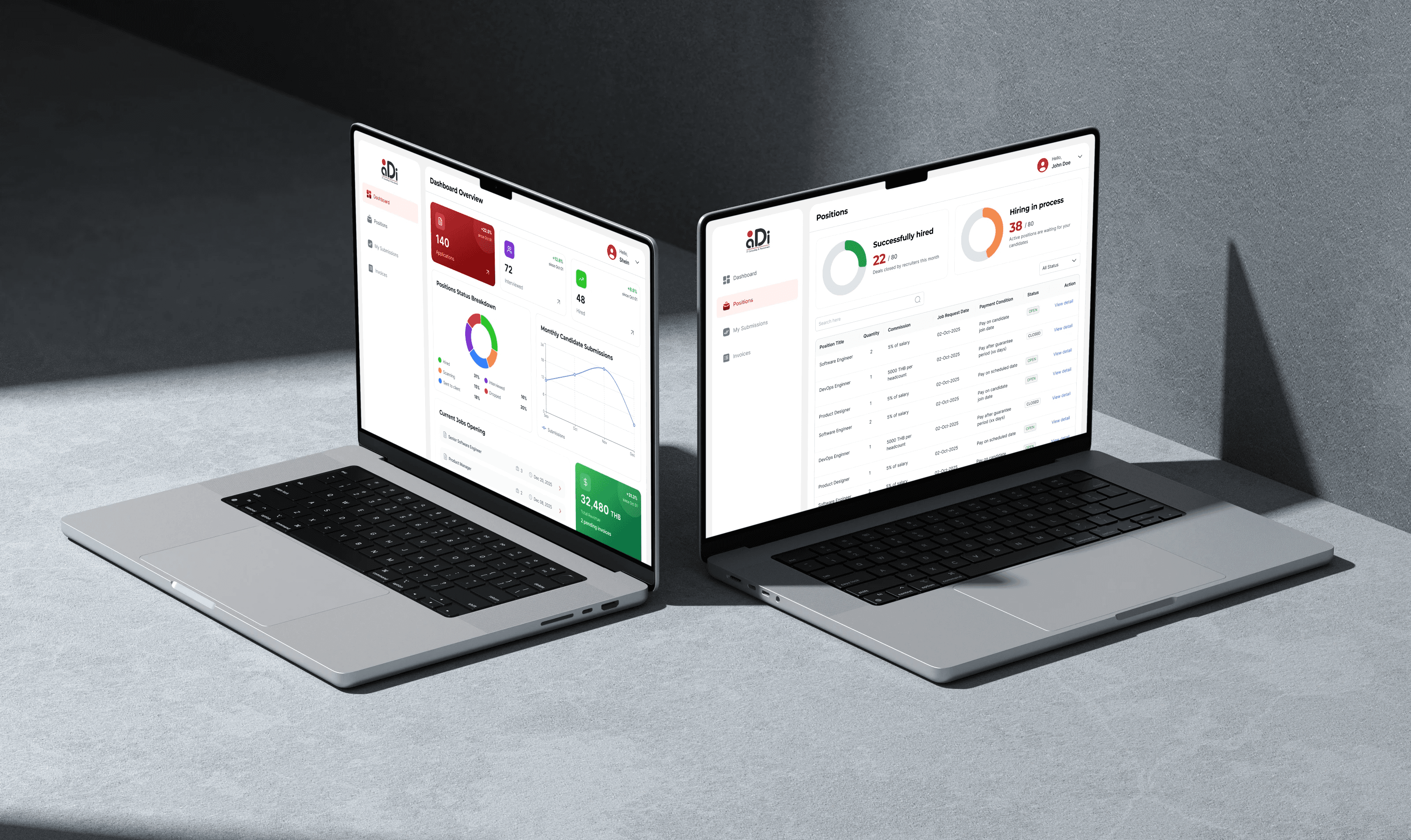
The first release focused on establishing the platform's operational foundation.
Alongside defining the visual identity, I created a scalable design system using design tokens, variables, and Atomic Design principles to ensure consistency across future product development while simplifying developer handoff.
The recruiter experience prioritized the workflows recruiters perform most frequently:
Opening positions
Submitting candidates
Tracking placements
Monitoring commission earnings
Invoice management
Every interaction was designed to reduce context switching and replace fragmented communication with a centralized workspace.

BUILDING THE DESIGN FOUNDATION
Before building the product, I established a cohesive design language by defining scalable color tokens, a clear type scale, and a spacing system so every component shares the same visual foundation.
Color
A unified color foundation designed for semantic scalability
Typography
Montserrat powers headings for authority; Inter handles body text for legibility across all densities.
TYPESTYLE
SIZE
WEIGHT
H1
48 / 56
Bold
H2
40 / 48
Bold
H3
32 / 40
SemiBold
H4
24 / 32
SemiBold
H5
20 / 28
SemiBold
P1
16 / 24
Regular
P2
14 / 20
Regular
P3
12 / 16
Regular
TURNING PATTERN INTO A SYSTEM
Instead of solving the same UI component problems repeatedly, reusable components allowed the team to apply consistent patterns across different recruiter workflows.
Default
Input here
Hover
Input here
Filled
Option
Disabled
Input here
Error
Input here
This field is required


EVOLVING THROUGH ITERATION
As development progressed, stakeholder priorities naturally evolved.
Originally, the public landing page was included in the initial release.
However, after reviewing delivery priorities, stakeholders decided the existing website continued to meet immediate business needs.
Rather than delaying the recruiter platform, we moved the landing page redesign into a later phase and concentrated resources on the product experience that would generate greater operational value.
This decision allowed the team to deliver the highest-impact functionality first.

RESPONDING TO CHANGE
Midway through development, although AI integration generated strong business interest, the team recognised that the feature lacked clearly defined user requirements. Instead of introducing unnecessary complexity, we reframed AI as a future capability.
For the initial release, we proposed an AI-powered chatbot as a lightweight MVP capable of assisting recruiters with common questions while allowing the team to gather real usage insights before investing in more advanced AI functionality.
ENHANCING THE FIRST EXPRESSION
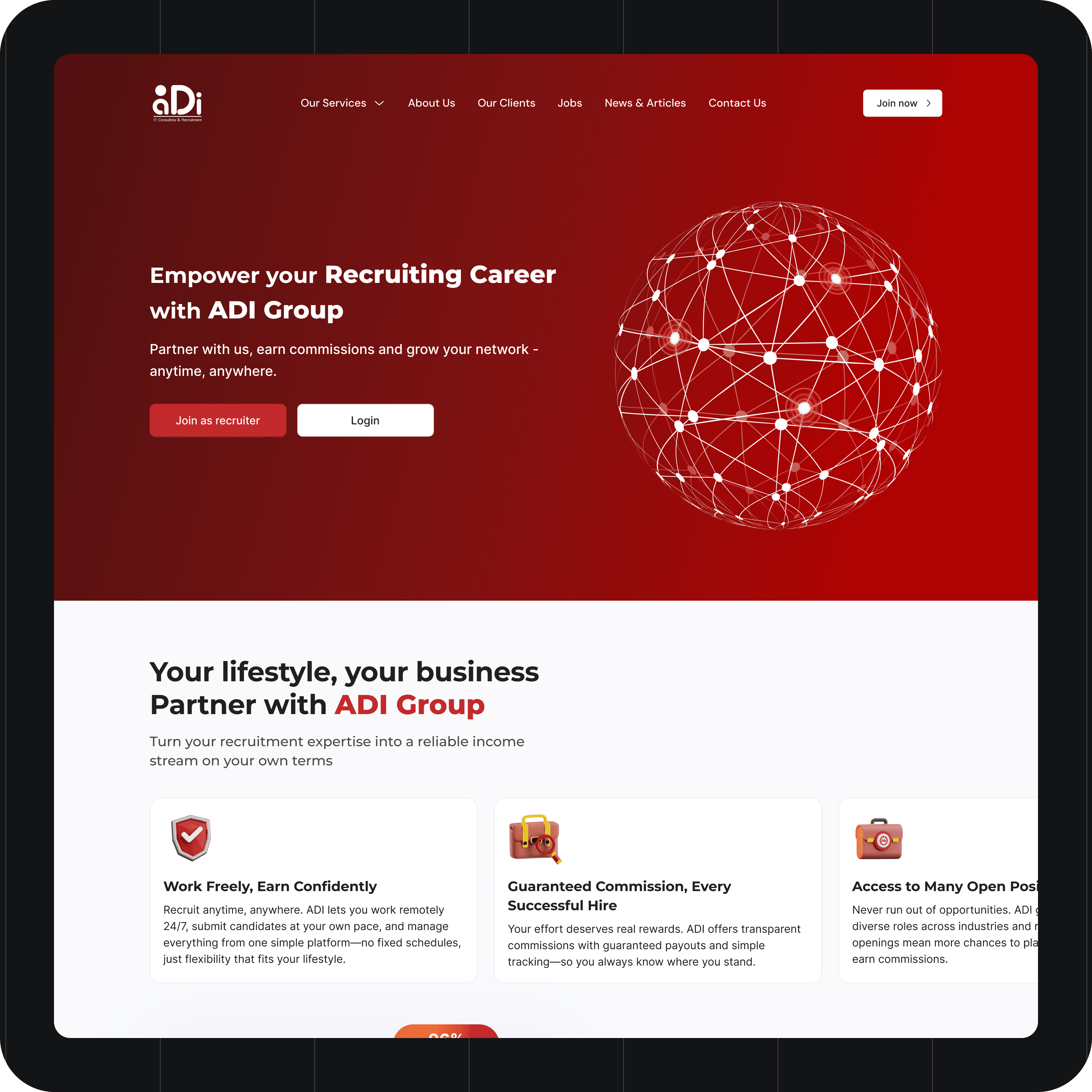
Alongside the recruiter dashboard, I also redesigned ADI's landing page to better communicate the company's value proposition and establish greater credibility with prospective recruiters.
The redesign introduced a clearer information hierarchy, stronger messaging, prominent client partnerships, and a simplified onboarding journey that encourages recruiter acquisition while supporting the company's growing employer brand.
Unlike the operational platform, the landing page focused on building trust before users entered the recruitment ecosystem.

FUTURE GROWTH
The platform was intentionally designed as a scalable foundation rather than a finished product.
Future releases will continue expanding recruiter capabilities through analytics, AI-assisted recruitment workflows, and additional operational tools as business requirements mature.
By establishing a flexible design system and modular product architecture early, the platform is well positioned to evolve alongside ADI's regional growth.

SUCCESS METRICS
Comparing with the existing recruitment workflow
40%
<4 mins
25%
REFLECTION
Designing this platform reinforced that successful products are built by balancing user needs, business goals, and technical constraints by not simply adding more features.
By prioritizing core recruiter workflows and making deliberate product decisions, we established a scalable foundation that can evolve alongside ADI's future growth.
